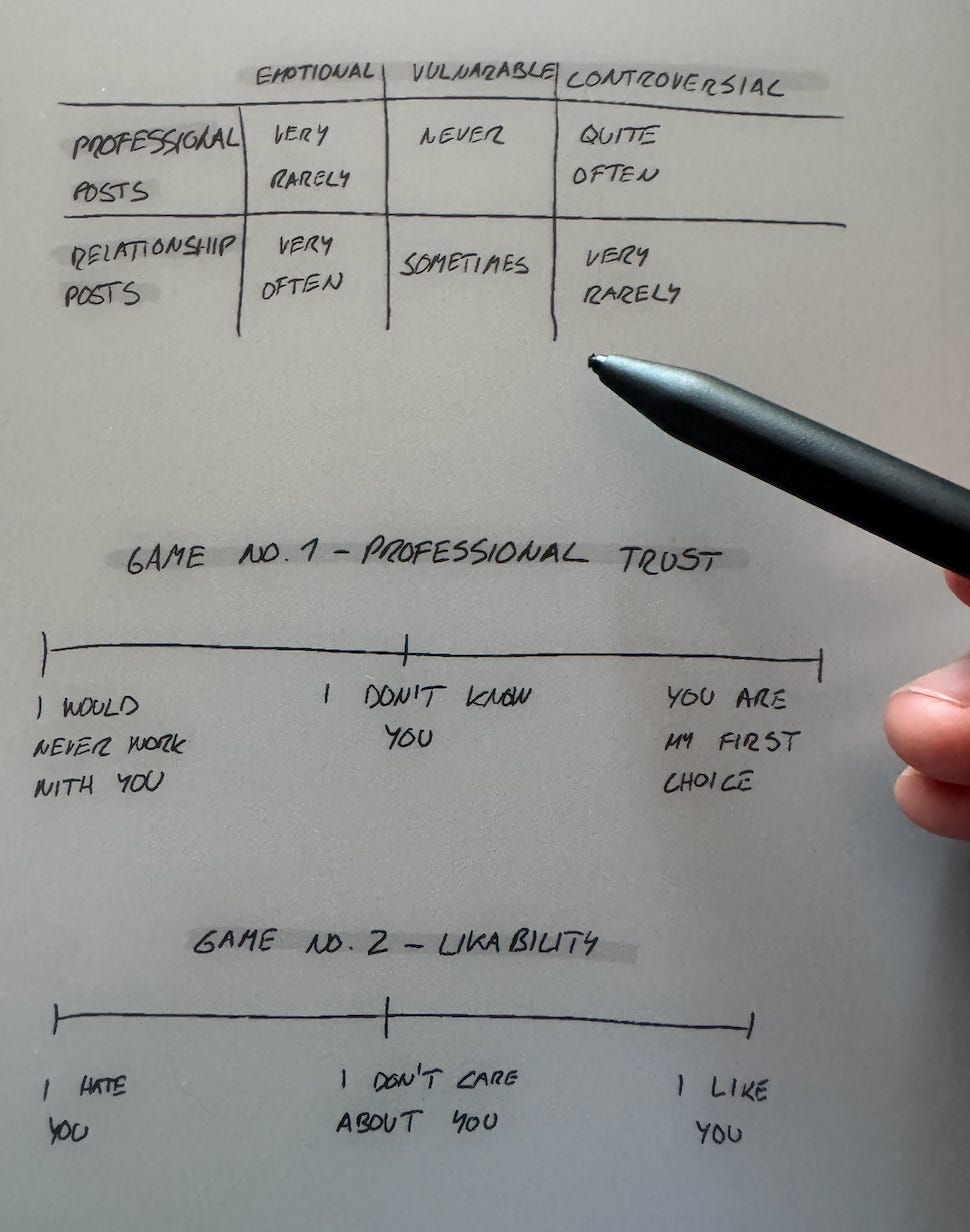
For most of us, it's approximately a 4:6 ratio. What does that mean?
Let's say you post 10 times per month, that is a solid strategy for almost everyone. Let’s say that you work in an informal industry and would like to be percieved as easy going professional.
So, you will concentrate a bit more on the social networking side of LinkedIn, and that will come at the reasonable expense of sharing professional information.
In four of your posts, you can concentrate on establishing your strong professional authority and trust - Game No. 1.
In the remaining six posts, you can focus on building a warm atmosphere of understanding and likability - Game No. 2.
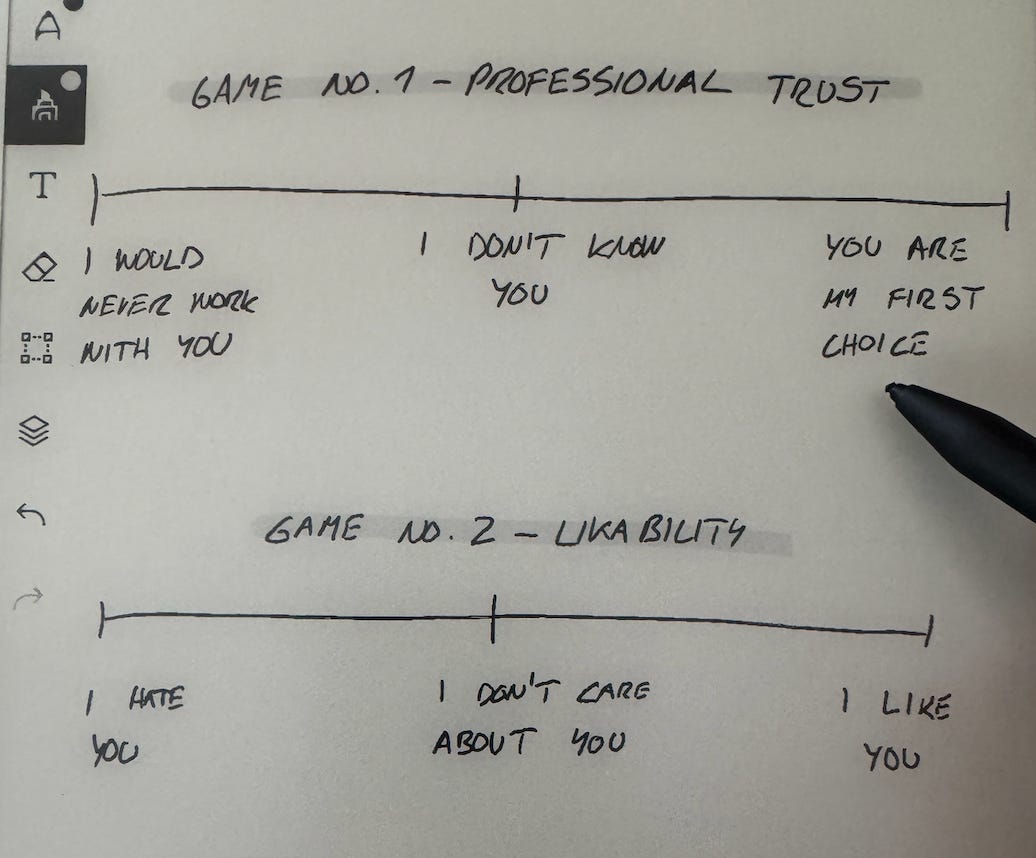
Of course, depending on your industry, region, and personality, you may choose a different ratio.
But basically, this is it: we won’t work with you if we don’t see you as one of the best in your field. You could be the absolute best in your field, and we might still prefer the No. 2 authority on the market due to our personal sympathies.
You might also tell me that you prefer to establish both professional and personal trust in the exact same posts, but honestly, that is a very hard thing to do. It's more convenient to concentrate on one task per post.
Now, let's jump down to the tactical level:
Game No. 1: PROFESSIONAL TRUST is played with carousels and articles that are part of newsletters. Of course, you can use all other post types too, but these two are great for this game. What you share is professional know-how and information. Most of the time, there is no rational reason for you to get emotional about it. For example, you might be excited about a piece of industry news from time to time, but you will come off as a weirdo if you are excited about everything. There is almost no room to be vulnerable without hurting your professional authority. However, you can easily be controversial by rationally proving other people’s professional points wrong.
Example: “I think people judge ghostwriting on LinkedIn too harshly. A good ghostwriter is like a good interviewer; they help the client express their real ideas and thoughts better.” This is a controversial yet fully professional post. But it would be crazy to end it with an idea like, “That is why I hate all the critics of ghostwriting. They remind me of my dad, who tried to prevent me from becoming a marketer in the first place.” That is unprofessional and would discourage many people from working with you.
Game No. 2: LIKABILITY is played with memes, sports, animals, flowers, and similar content. Of course, you can skip illustrating your posts, but if you have authentic or entertaining pictures, now is the time to use them. In this game, the topics you discuss are only remotely attached to your work life. These are more personal topics where you can get more emotional and sometimes even vulnerable. But don’t be too controversial.
Example: “You may laugh at me, but until I was 31, I didn’t have a driver’s license. I didn’t need one.” This is a good start for your LIKABILITY post. But it would be crazy to end it with a statement like, “That is why I feel people should quit driving cars and just use public transport.” Making such a point would be bad for your image, unless you are an expert in the area and have solid facts to support this argument. However, that would switch you back to Game No. 1, because it would then become a professional topic. In that game, though, you would lose for using that emotionally vulnerable beginning to the post.