
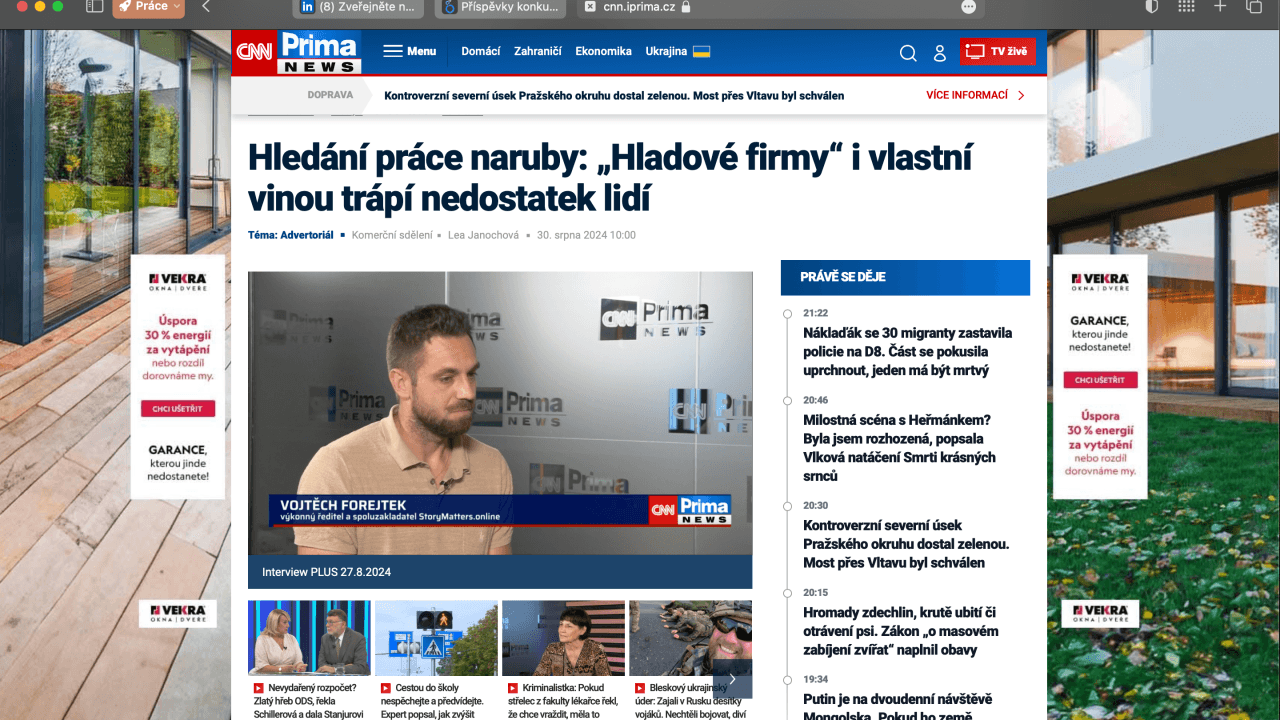
Job hunting isn't what it used to be. Have you noticed? The labor market situation has long favored employees. Companies are competing fiercely to offer better conditions when searching for new hires, often due to an acute shortage of qualified people. And modern technologies play a crucial role. For example, social networks are no longer just for entertainment. Professionally-oriented ones can connect us with job opportunities we would hardly learn about otherwise. However, it's important to know how to navigate them and use them to your advantage. This applies to both employees and companies. If you want to know more, read on. In this episode of Interview PLUS, the main voice belonged to Vojtěch Forejtek, CEO and co-founder of StoryMatters, who believes that the biggest mistake we can make today is not making ourselves known.

Video available at the link below.
Link to the full article and video interview can be found here - https://cnn.iprima.cz/hledani-prace-naruby-hladove-firmy-i-vlastni-vinou-trapi-nedostatek-lidi-446101
Unemployment rose slightly in July this year, yet many recruiters at Czech companies are still struggling to find much-needed qualified workers. Why? Vojtěch Forejtek offers an answer: "I think it's because they're not utilizing the potential of the system for how to search for qualified people," says the representative of StoryMatters online on CNN Prima NEWS. And he continues: "From experience, we can say that today, recruiting people is about sales... In the past, people applied for job positions, today companies offer job positions to candidates."
He knows what he's talking about. The company he co-founded is built on helping companies recruit new employees and generate business meetings. It uses networks like LinkedIn. They teach their clients to navigate it and fully leverage its potential. So what should every company do? "The main potential lies in putting key people forward to the market... If a company has a team leader, say a sales team director, and is looking for salespeople, that director should communicate on behalf of the company to those salespeople... That's where I'd start. Then it's crucial to build a network of relevant contacts on LinkedIn who could either join the company or need to have diversified connections and create content for them. And when they create content, they can measure how people interact with it, see who they have influence over, and can invite them to engage."
Do all interviews start on LinkedIn?
According to experienced HR managers, having a LinkedIn profile is essential today. And it seems that even the mentioned company representatives have started to understand this and are building profiles themselves.

Quote from the article.
Besides just being present on LinkedIn, he also mentions the ability to fully utilize its potential. "There's an option to expand LinkedIn with premium accounts. If we're talking about the recruiting world, you can get recruiting premiums that have certain search functionality that allows you to target better, etc. Still, I think the most important premium, whether your goal is recruiting or sales, is the Sales Navigator Advance premium account, because it allows both options. And since today we perceive recruiting as more like sales, the business premium account works best of all in my opinion."
Above all, don't stay silent!
The CEO of Storymatters.online considers the biggest mistake to be the inability to communicate — as he says, from fear that the market isn't interested in them.

Quote from the article.
And how do you make the algorithm "like" you? First of all, you need to have an optimized profile, the experienced professional advises. "That's the crucial thing for me, because the social network likes it when we don't hide anything from it. And the more information we provide, the more it gives us. Based on that, build a contact network, because that's one of the aspects the algorithm values most, whether we're connecting with new people or not, and then it's our own activity. If we create content, it will like us more, if we engage more in discussions with other people, if we show more interest in other people's activity, it will like us even more. And the fourth parameter is how we're perceived by the community, meaning whether other people want to connect with us and whether they accept our requests," explains Vojtěch Forejtek. "Based on this, LinkedIn creates a kind of mirror of us, it's called Social Selling Index, and there we collect positive and negative points, and the more points we have, the more we're in a situation where LinkedIn likes us and recommends us more."
Content in the lead role: Photos, videos, and plain text
As experienced social media users know, it's primarily about content. And Vojtěch Forejtek confirms this even in the professional environment. So it's important to actively contribute and thus reach potential contacts. "On LinkedIn, plain text works best as standard, because it's a professional social network. And if someone is a CEO of an industrial factory and is around sixty years old, plain text is something they're able to publish, we'll probably never get a selfie from them. Then of course any visual content works very well, if we use a photo, video, it's excellent content. Polls work very well, because most users are passive followers. They won't give you a like or comment, because it would be visible that instead of running the company, they're on LinkedIn for procrastination purposes. So they engage with an invisible action — they read or for example vote in polls, where the vote may not be publicly visible."
Link to the full article and video interview can be found here - https://cnn.iprima.cz/hledani-prace-naruby-hladove-firmy-i-vlastni-vinou-trapi-nedostatek-lidi-446101