
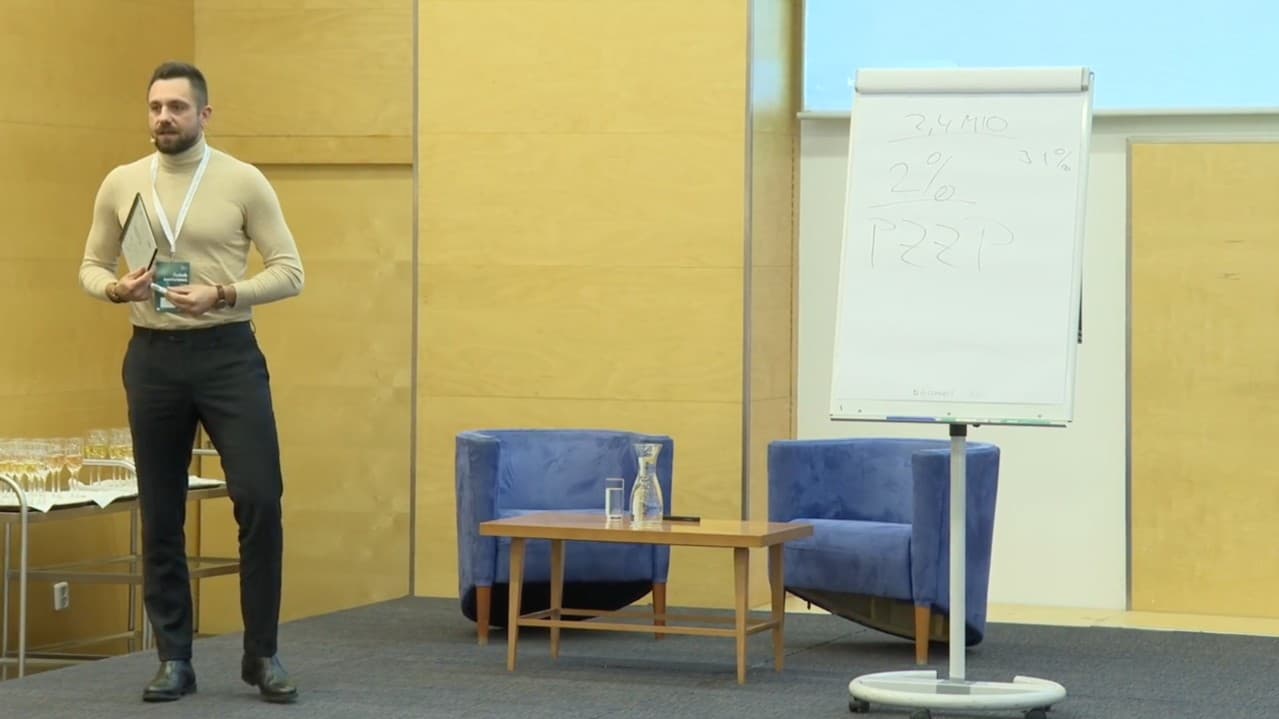
Two percent of LinkedIn users create content. That's not much. But the question is – is it a problem, or an opportunity?
Czech LinkedIn has over two point four million users. Year-on-year, it grows by roughly thirty-one percent.
At the same time, only two percent of people publish any content at least once every thirty days.
At the Ryba smrdí od hlavy conference, I led a discussion with directors, owners, and sales leaders about what this statistic means. And most of them clearly agreed – it's an opportunity. We just don't know how to leverage it well yet.
And that's exactly what my presentation was about.
I break down the strategy we've internally named P-W-M-C.
P as in Plus.
On LinkedIn, we're the only ones actively seeking out contacts, filtering them, and connecting with people who have real decision-making authority.
W as in Warm up.
We don't create content for likes and comments. Unless you're an egomaniac, you do it for rational value – and that's the ability to measure the other party's interest.
M as in Measure.
There are two types of users on LinkedIn.
Some admit it publicly – they give likes, comment, visit your profile. These ten visible actions can be precisely tracked and evaluated.
Others just read. They're the majority. Often directors or business owners who can't afford to publicly declare they're currently looking for solutions. But they read, stop by, watch. And we can tell.
Using Sales Navigator Advanced, which has the Buyer Intent feature unlike the basic version, we can decode these signals.
This tool categorizes customers into four states:
Negative – repeatedly doing what we don't want.
Neutral – not harmful, but not responding either.
Moderate – showing some interest.
High – repeatedly and intensively giving us their time.
And finally C as in Convert.
If a user shows interest – whether visibly or invisibly – it's very likely they're considering us.
That's when the right time comes for a call to action for a business meeting.
A short message. Two to three sentences. The first is a call to action – let's have a call, meet up. The second sentence states what you're after.
No links, no words like order, offer, cooperation. Don't sign off, don't say thanks – LinkedIn isn't email, it's chat.
On the other hand – the read rate of these messages is at email level. Don't expect an immediate response.
I'm sharing the full presentation here:
https://drive.google.com/file/d/1GTSxNtUH_5E3SPj2Ci9_KAtNuAlqEvps/view?usp=share_link